Global
Türkiye
Americas
Bangladesh
India
Việt Nam
Indonesia
پاکستان
中国
close

Toxicology: The Scientific Foundation of Biocompatibility

Risk-Based Evaluation Beyond Default Test Panels

Biocompatibility assessment begins with understanding patient exposure. Toxicological Risk Assessment (TRA) evaluates whether chemical constituents (identified during ISO 10993-18 characterization) present a risk under intended clinical use.

TRA translates analytical data into documented safety conclusions that can be reviewed by regulatory authorities.

At Hohenstein Medical, we go beyond default biocompatibility test panels. Our approach starts where true patient safety begins: understanding chemical exposure. Toxicological Risk Assessment (TRA) transforms analytical findings into clear, defensible safety conclusions that regulators can trust.

Led by a board‑certified toxicologist (ERT, DABT), our integrated ISO 10993‑18 and ISO 10993‑17 workflow ensures that chemistry and toxicology speak the same scientific language — from analytical data generation to final risk interpretation.

Understanding Toxicological Risk Assessment

Connecting chemistry, exposure and patient safety
What

What Is a Toxicological Risk Assessment?

A structured, exposure-based evaluation under ISO 10993-17:2023

A Toxicological Risk Assessment is a systematic, exposure-based evaluation of identified chemical constituents.

A TRA is a systematic assessment of chemical constituents identified during extractables and leachables testing. It connects analytical data with patient exposure to determine whether a substance poses a risk under intended clinical use.

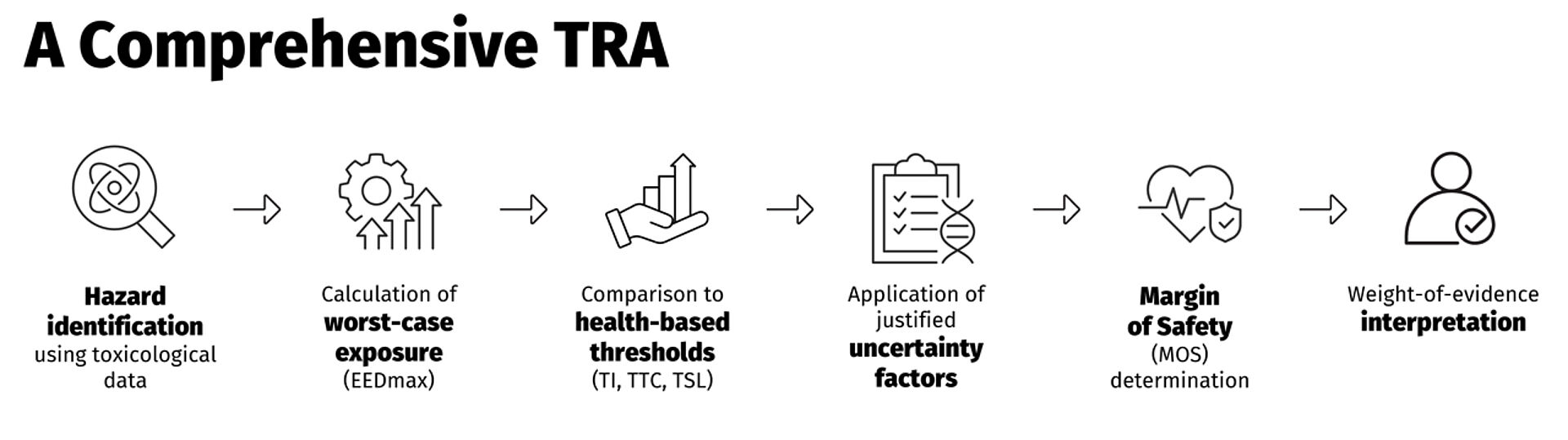
A comprehensive TRA includes:

  • Hazard identification using toxicological data
  • Calculation of worst‑case exposure (EEDmax)
  • Comparison to health‑based thresholds (TI, TTC, TSL)
  • Margin of Safety (MOS) determination
  • Application of justified uncertainty factors
  • Weight-of-evidence interpretation

The result is fully documented in a formal risk assessment report. The final report clearly states the toxicological risk conclusion in accordance with ISO 10993-17:2023 requirements.

Why

Why Does Toxicological Risk Assessment Matter?

Regulators expect scientific justification, not assumptions.

ISO 10993-1 requires a risk-based biological evaluation. Authorities want to see how chemical findings translate into real‑world exposure and patient safety.

TRA answers the key questions:

  • What substances were found?
  • At what levels?
  • How much would a patient be exposed to?
  • How does this compare to toxicological thresholds?

TRA also supports:

  • Root‑cause analysis when biological tests show unexpected results
  • Informed decision-making early in development
  • Continuous risk management throughout the product lifecycle

How

How Do We Perform a TRA?

From extraction strategy to defensible risk conclusion

A TRA is only as strong as the chemical data behind it. Extraction design (solvent, temperature, time, surface area) determines which compounds appear and at what levels.

Our evaluation includes:

  1. Identification of constituents from ISO 10993‑18 studies
  2. Assessment of Toxicological Screening Limits (TSL)
  3. Derivation of Tolerable Intake (TI) or application of Threshold of Toxicological Concern (TTC)
  4. Calculation of worst‑case exposure (EEDmax)
  5. Calculation of Margin of Safety (MOS)
  6. Application of uncertainty factors
  7. Weight‑of‑evidence risk conclusion

When exposure is below applicable thresholds, certain biological endpoints may be addressed through toxicological analysis. If elevated risk is identified, the chemical profile supports targeted mitigation measures such as material modification, cleaning adjustment or process refinement.

When

When Is a TRA Required?

Common scenarios across the product lifecycle

A TRA is typically conducted when:

  • Chemical characterization identifies reportable constituents
  • Estimated exposure exceeds screening thresholds
  • Preparing FDA 510(k), De Novo, PMA or EU MDR submissions
  • Material, supplier, sterilization or process changes alter the chemical profile
  • A Biological Evaluation Plan requires toxicological justification
  • A test result requires investigation of potential chemical causes

TRA supports ongoing risk management when materials, suppliers or processes change.

Who

Who Performs the TRA?

Toxicological interpretation requires specialized training.

Analytical testing identifies chemical constituents, which must then be evaluated for relevance to patient safety.

Exposure modeling, threshold derivation and uncertainty factor application require specialized toxicology training.

Board-certified Toxicologist

Dr. Isabel Groh, PhD, ERT, DABT

At Hohenstein Medical, TRA is led by: Dr. Isabel Groh, PhD, ERT, DABT

  • European Registered Toxicologist
  • Diplomate of the American Board of Toxicology

Board certification reflects formal examination, professional qualification and ongoing toxicology education. Dr. Groh’s experience at a medical device OEM provides practical insight into material selection, process changes and regulatory timelines, informing how studies are structured and how findings are interpreted.

ISO 10993-17:2023 - Standardized Exposure-Based Framework

The 2023 revision strengthens scientific rigor in toxicological risk assessment.
  • Toxicological Screening Limits (TSL)
    TSL applies only to identified constituents, not to certain populations or cohort-of-concern substances. Proper application requires toxicological judgment. For identified constituents:
    • Short-term exposure (≤30 days): 120 µg
    • Long-term exposure (>30 days): 600 µg
  • Assumed Release Modeling
    ISO 10993-17:2023 allows adjustment of EEDmax based on release duration, aligning toxicity data duration with exposure timeframe. This improves scientific defensibility, especially for prolonged- and long-term devices.
  • Updated Terminology
    Legacy terms such as “Allowable Limit” are not consistent with ISO 10993-17:2023 and should not be used in current TRA documentation.

ISO 10993-17:2023 - Standardized Exposure-Based Framework

The 2023 revision formalized an exposure-based approach to toxicological risk assessment.

Toxicological Screening Limits (TSL)

TSL applies only to fully identified constituents, not to certain populations or cohort-of-concern substances. Proper application requires toxicological judgment. For fully identified constituents:

  • Short-term exposure (≤30 days): 120 µg
  • Long-term exposure (>30 days): 600 µg

Assumed Release Modeling

ISO 10993-17:2023 allows adjustment of EEDmax based on release duration, aligning toxicity data duration with exposure timeframe. This improves scientific defensibility for prolonged- and long-term devices.

Updated Terminology

Legacy terms such as “Allowable Limit” are not consistent with ISO 10993-17:2023 and should not be used in current TRA documentation.

Integration with Chemical Characterization

One team. One workflow. One defensible conclusion.

A TRA is only as reliable as the chemical data it uses.

Misaligned extraction conditions can distort exposure estimates — and regulatory outcomes.

A common error is abandoning chemical interpretation when chromatograms appear complex. Without interpretation, peaks are unknowns. With toxicological analysis, they become context:

  • Manufacturing residues
  • Cleaning agents
  • Polymer additives
  • Material degradation products

Hohenstein Medical integrates ISO 10993-18 chemical characterization and TRA within one ISO/IEC 17025-accredited, GLP-compliant lab team, ensuring continuity between analytical data generation and toxicological evaluation.

Regulatory Defensibility in Toxicological Risk Assessment

Clear documentation and scientific justification aligned with ISO 10993-17
Expectations

What Do Regulators Expect?

Regulatory review focuses on scientific justification and consistency.
  • Analytical Evaluation Threshold (AET) Justification
    Reported thresholds used in chemical analysis must be supported by documented rationale.
  • Exposure Calculations
    EEDmax calculations should be transparent and reproducible. Assumptions regarding device use, patient population and release conditions must be documented.
  • Threshold Selection
    • The selection of Toxicological Screening Limits (TSL), Tolerable Intake (TI) or Threshold of Toxicological Concern (TTC) must be clearly explained
    • When TTC is applied because compound-specific toxicology data are not available, the justification should be documented
    • If uncertainty factors are applied to toxicological reference values such as the No Observed Adverse Effect Level (NOAEL) or the Lowest Observed Adverse Effect Level (LOAEL), each factor should be described and supported
  • Logical Scientific Narrative
    Common regulatory deficiencies include incomplete exposure modeling, insufficient threshold justification and conclusions not fully supported by data. A complete TRA links:
    • Chemical identification
    • Exposure estimation
    • Threshold comparison
    • Margin of Safety calculation
    • Risk conclusion
Endpoints

Addressing Biological Endpoints Through Toxicological Risk Assessment

Justifying endpoint coverage under ISO 10993-1

ISO 10993-1 permits certain biological effects/endpoints — including systemic toxicity and, in defined contexts, genotoxicity — to be addressed through chemical characterization and toxicological evaluation when supported by exposure data.

To be considered defensible, the TRA must clearly document:

  • The identified chemical constituents
  • The estimated patient exposure (EEDmax)
  • The applicable toxicological threshold (TSL, TI, or TTC)
  • The resulting Margin of Safety (MOS)
  • The rationale for concluding that additional biological testing is not required

When exposure remains below justified thresholds, and the toxicological assessment is fully documented, regulators may accept chemical characterization and TRA in place of separate biological testing for those endpoints.

This determination must be supported by transparent methodology and consistent application of ISO 10993-17.

Support

Regulatory Submission Support

Toxicological documentation for global markets

Hohenstein Medical supports TRA documentation for:

  • FDA 510(k), De Novo and PMA submissions
  • EU MDR Technical Documentation
  • Biological Evaluation Plans (BEP)
  • Biological Evaluation Reports (BER)
  • Material and process change assessments
  • Regulatory deficiency responses

Why Hohenstein Medical?

Scientific Rigor. Certified Toxicological Expertise. Regulatory Alignment.
  • ISO/IEC 17025–accredited, GLP-certified laboratory
  • Integrated chemical characterization, biocompatibility and TRA within one scientific team
  • Board-certified toxicologist (ERT, DABT) oversight
  • Study design aligned with device type and clinical exposure
  • U.S.-based team aligned with global regulatory expectations
  • Experience supporting FDA and EU MDR submissions
Contact
Katie Brinkman
Medical Device Program Manager
Hohenstein Medical